
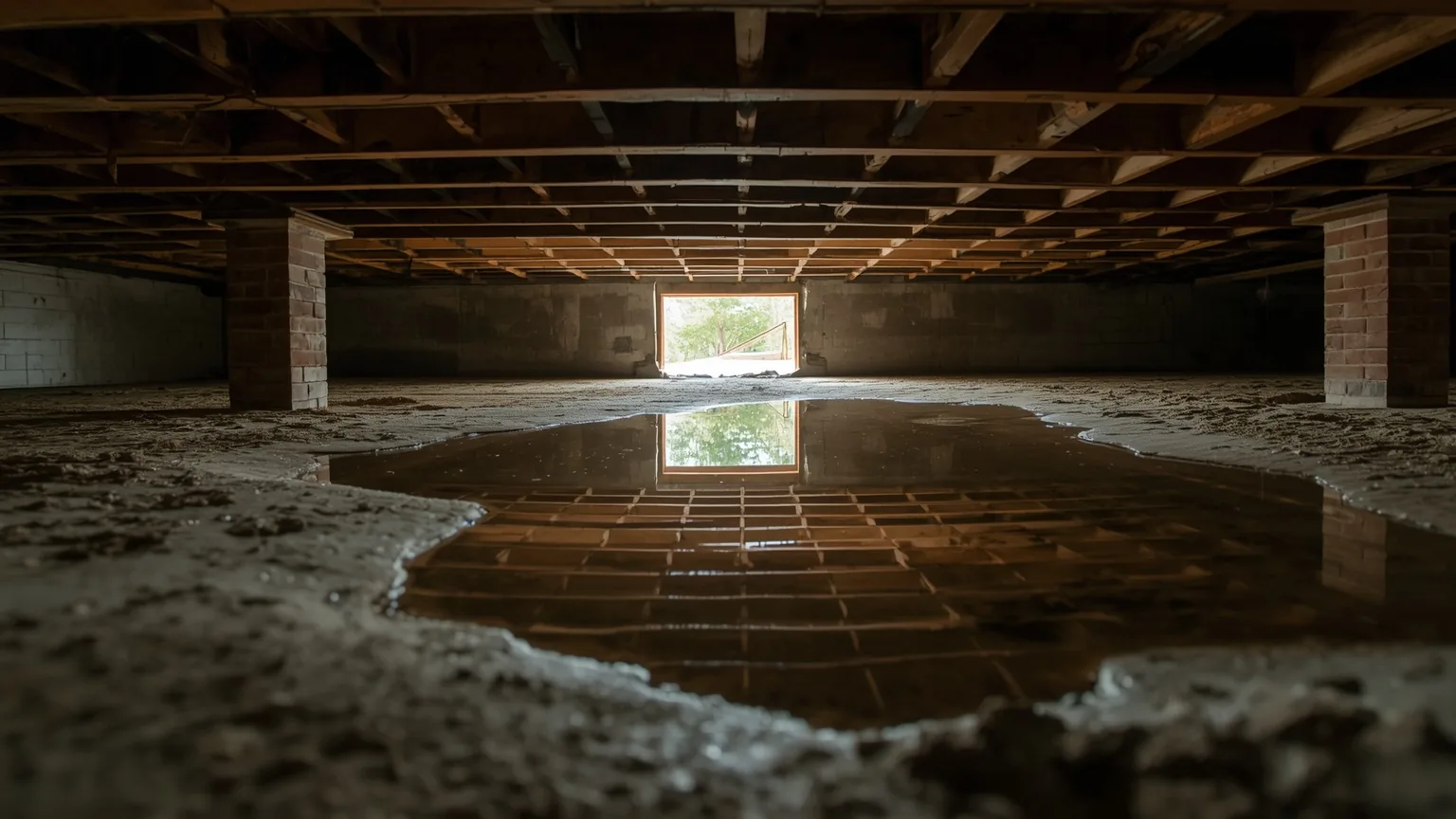
A crawl space that is wet after a storm is easy to explain. One that is wet on a clear week in October is the more interesting problem, and it usually has one of two answers.
Why is my crawl space wet when it hasn't rained?
Two mechanisms account for most cases. Either groundwater is sitting high enough to reach the crawl space floor independently of recent rainfall, or warm humid air is entering through the vents and condensing on cooler surfaces. The first produces water on the ground; the second produces water on ducts, pipes and the underside of the subfloor. Where the water appears tells you which.
How do I tell groundwater from condensation?
Look at what is wet, not just whether something is:
- Wet ground, dry pipes — groundwater. The moisture is arriving from below.
- Beading on ducts and pipes, ground no wetter than usual — condensation. The moisture is arriving as air.
- Both — common here, and it means two remedies in sequence rather than one.
- A localized wet patch under a bathroom or kitchen — neither. That is a plumbing question and worth eliminating first because it is a different trade.
Why would groundwater be high with no rain?
Because the water table is not a direct function of last week's weather. Several soil series described by the USDA from type locations inside Charleston County carry a water table at or near the surface for months at a stretch — the Yonges series is recorded as having a water table within 10 inches of the surface for about six months in most years, and Stono and Wadmalaw soils as having one above or near the surface for as much as six months a year.
On a low lot, that is a seasonal condition rather than a storm response. It is also why sandy soil is not the reassurance it sounds like: the Kiawah series is described as having rapid permeability that is nonetheless impeded by the high water table. Fast-draining ground does not help when there is nowhere lower for the water to drain to.
Does the tide have anything to do with it?
On low-lying lots near a creek or the marsh it can, though usually indirectly — by holding groundwater higher rather than by water arriving overland. NOAA's Charleston Harbor tide gauge counted an average of 0.3 high-tide flood days a year through the 1960s; across 2015 to 2024 that average was 9.6, with 19 in 2023. That trend is about water levels generally, not about your crawl space specifically, but it is the background against which a low lot behaves.
What should I do about it?
Record it before you buy anything. Dates, what was wet, whether it had rained, and photographs. A contractor visiting on a dry day cannot see any of that, and it is the difference between a diagnosis and a guess.
Then match the remedy to the mechanism. Groundwater points to drainage and possibly a sump system. Condensation points to sealing and moisture control. Buying the wrong one is expensive and does not fail obviously — it simply does not work.